UsageTapFree PDFs · No signup
2 free workbooks · 20 practical checks

Ship the AI.Keep the economics.

Two field guides for the moment AI usage gets real: one for products about to launch, one for established software adding variable-cost AI.

Free PDFs · Instant download · Use with any stack

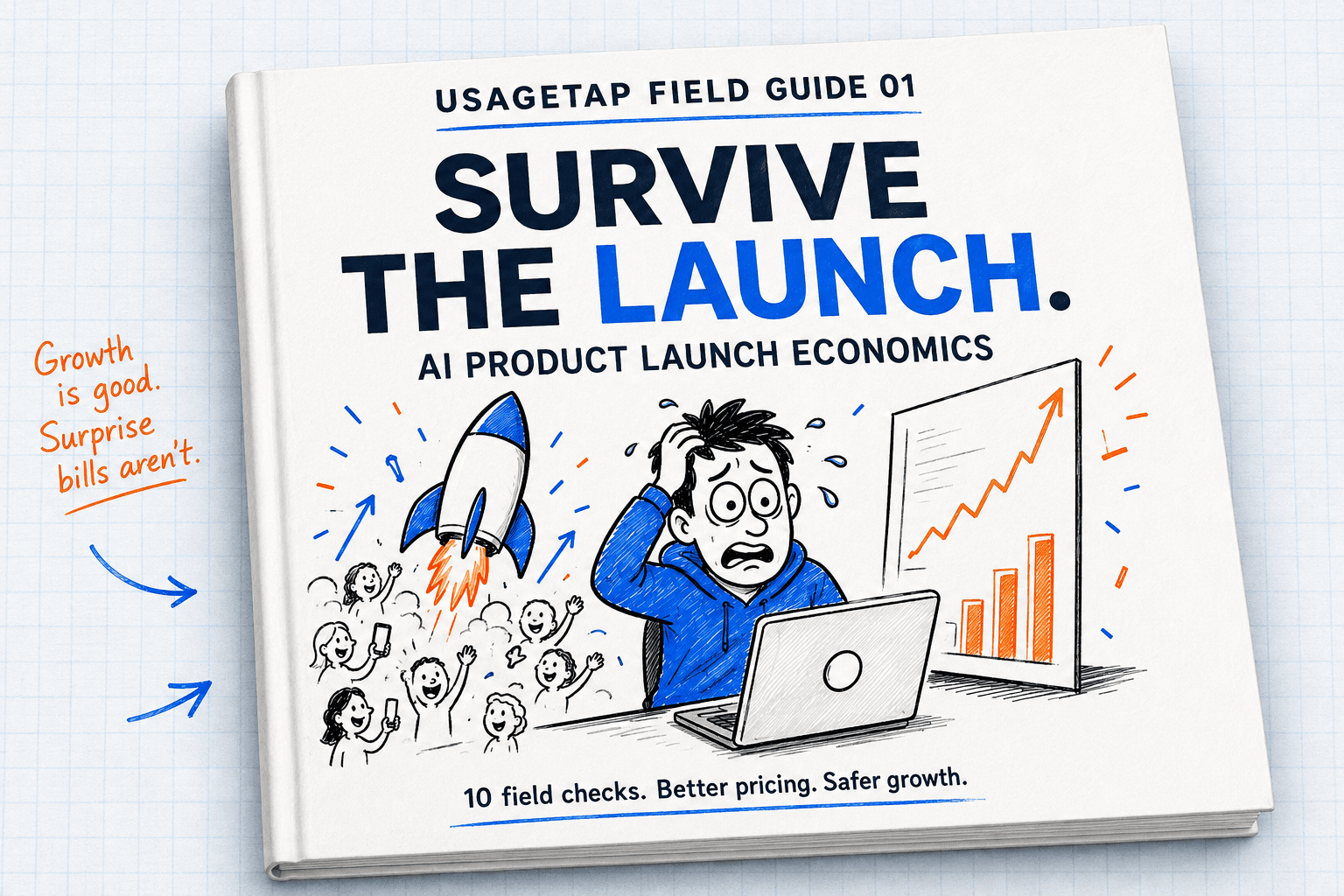
Survive the launch field guide cover with a rocket, a founder, and rising AI costs.
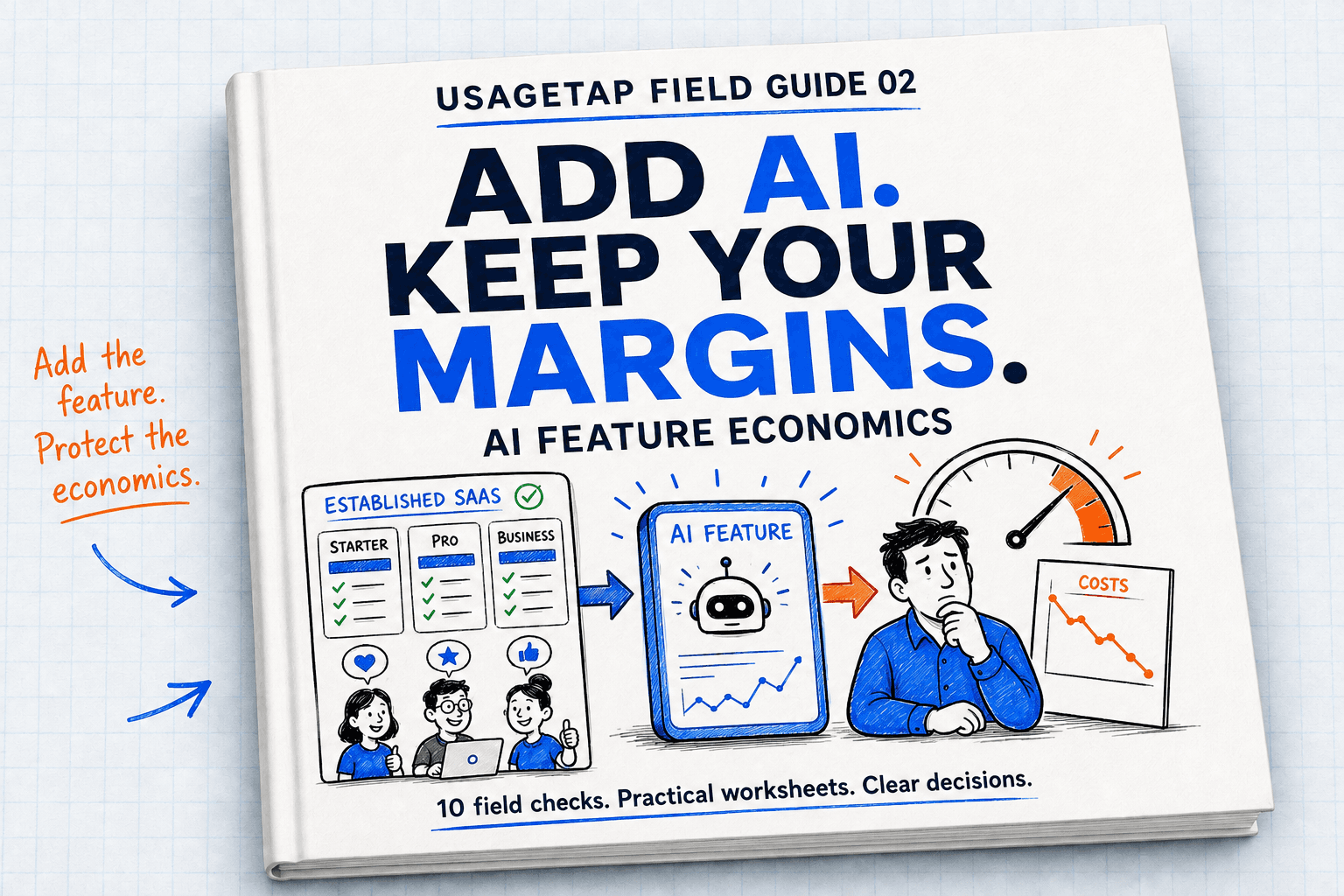
Add AI and keep your margins field guide cover showing an AI feature added to an established product.

Growth is good.
Surprise bills aren't.

5-minute exercises

Rough math before false precision

Vendor-neutral

Use your logs, provider data, or a spreadsheet

Built to write in

Decisions, budgets, limits, and readiness cards

Start where you are

Same AI. Different economics problem.

Pick the guide that matches the commercial moment your team is in today.

Survive the launch field guide cover with a rocket, a founder, and rising AI costs.FIELD GUIDE 01

Launching a new AI product

Survive the launch

Model the cost of success before a free tier, launch spike, or power user turns traction into a surprise bill.

Five questions you will answer

  • What does one useful customer task cost?
  • What happens at 10x or 100x adoption?
  • How much AI can the free tier afford?
  • Where is the expensive 5% of usage?
  • What stops a runaway agent task?
PDF · 24 pages · 10.9 MB · No signup requiredDownload PDF
Add AI and keep your margins field guide cover showing an AI feature added to an established product.FIELD GUIDE 02

Adding AI to an existing product

Add AI. Keep your margins.

Connect new variable AI costs to the plans, customers, and margin expectations your product already has.

Five questions you will answer

  • How did AI change the plan margin?
  • Which accounts create hidden cross-subsidy?
  • What value unit will customers understand?
  • What does “AI included” actually include?
  • Which evidence should trigger a pricing review?
PDF · 26 pages · 11.2 MB · No signup requiredDownload PDF

Leave with decisions

The useful unit is the completed task.

Customers do not buy calls or tokens. Start with the useful job, then work outward to scale, limits, optimization, and pricing.

01

Measure

Cost per useful task, not just per model call.

02

Stress-test

Launch spikes, heavy users, and agent loops.

03

Bound

Free usage, included allowances, and worst cases.

04

Decide

The signals that should change pricing or packaging.

Not another thought piece

Read a question. Do the math. Write one decision.

Each field pairs a short explanation with a five-minute exercise, a “do now / not yet” filter, and a concrete exit condition.

  1. 1TraceFollow one real customer task from request to useful result.
  2. 2CalculateAdd every model, tool, retry, and variable AI cost.
  3. 3DecideWrite the budget, guardrail, or pricing trigger before moving on.
Field exercise5 minutes

Trace one real task

Pick one thing a customer actually does. Count the whole workflow, not only the first model call.

Before you move on: You can state the approximate variable AI cost of one useful outcome without opening a provider dashboard.

Common questions

Useful even if you never use UsageTap.

Are the guides really free?+

Yes. Both PDFs download immediately, with no form, account, or email signup.

Do I need UsageTap to complete them?+

No. Use provider dashboards, your logs, a spreadsheet, or whatever tooling you already have.

Which guide should I start with?+

Use Field Guide 01 before a new product, free trial, cohort, or launch spike. Use Field Guide 02 when AI is entering a product with existing customers, plans, and margin expectations.

How long will this take?+

Each guide contains ten five-minute exercises. Work through it in one focused session or take one field into each team meeting.

30-minute application readiness review

Bring your launch plan. Leave with a sharper one.

We will work through the economics, guardrails, and priorities with you. No pitch deck or UsageTap commitment required.

Book a readiness review